

WEILL CORNELL ADVOCATES ON CAPITOL HILL
AACR Advocacy Day on Capitol Hill: Amplifying the Need for Sustained Cancer Research Funding
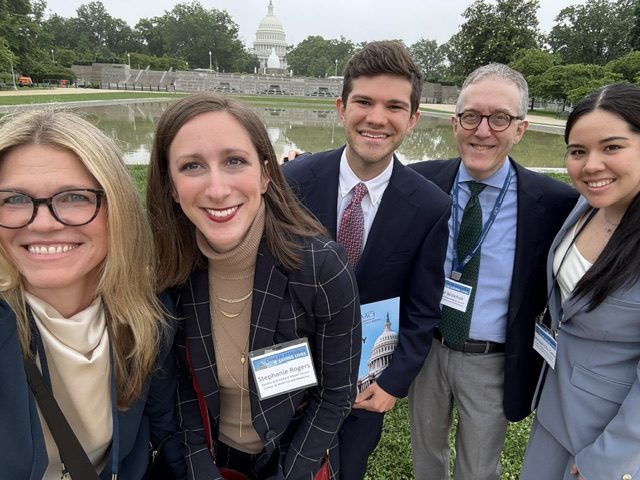
CBTP Program Director Cindy Campbell was recently invited by the American Association for Cancer Research (AACR) to join colleagues from the Sandra and Edward Meyer Cancer Center at Weill Cornell Medicine in Washington, D.C., to advocate for continued and strengthened federal investment in cancer research.
Our delegation met directly with both New York State Senators, as well as Members of Congress representing Districts 8, 12, 13, 18, and 19. These meetings provided an important opportunity to share firsthand perspectives from the front lines of pediatric and adult cancer research and to underscore the urgent need to protect and expand federal funding streams that support scientific discovery, clinical trials, and translational innovation.
Joined by advocates from Columbia and NYU, the team spoke about the extraordinary progress made in cancer research over the past decades—progress that has only been possible because of sustained federal investment through agencies such as the National Institutes of Health and the National Cancer Institute. They also discussed the growing vulnerability of this progress in the face of recent disruptions, including significant proposed and enacted funding cuts, the dismantling of the Pediatric Brain Tumor Consortium, and increasing uncertainty around long-term support for collaborative, multi-institutional research initiatives.
For those working directly in pediatric neuro-oncology, these policy shifts are not abstract. They have immediate and tangible consequences for children facing devastating diagnoses such as diffuse midline glioma, where time is measured in months and research momentum is critical.
What stood out most in these meetings was the bipartisan recognition that cancer research is not optional—it is essential. Every Member of Congress we met expressed support for continued innovation and a shared commitment to improving outcomes for patients and families. Our role was to ensure that the urgency behind that commitment is fully understood in real-world terms: in the pace of trials, the stability of research teams, and the continuity of promising scientific programs.
Advocacy is a natural extension of the work we do in the lab and clinic. While science moves forward through experiments, data, and clinical trials, it also depends on sustained policy support that allows that work to continue without interruption. These meetings reaffirmed the importance of showing up, telling our patients’ stories, and ensuring that pediatric brain tumors remain a national research priority.
We are grateful to AACR for convening this effort and to our congressional representatives for their time and engagement. The path forward in cancer research requires both scientific innovation and sustained public investment—and we remain committed to advancing both.